 |
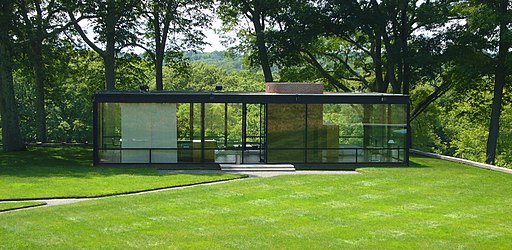
| Philip Johnson's Glass House (1947-49), which he said was
inspired by the denuded chimney of a house that was destroyed by the
Nazis. (Photo credit: Staib, CC BY-SA 3.0
<https://creativecommons.org/licenses/by-sa/3.0>, via Wikimedia
Commons) |
I
suppose Part 1 should have been enough about the underside of our Johnsons. Yet,
hard on the heels of the Seward folly comes another riposte from
the cancel culture of modern arts activism. "Erasing Philip Johnson's
Name" was the original title of the NY Times article that describes the
open letter of the "Johnson Study Group" (okay... hereafter "JSG") calling on MOMA and
other institutions "to remove the name of Philip Johnson from every
leadership title, public space and honorific of any form" due to
Johnson's "widely documented white supremacist views and activities". A week later Harvard University responded by changing the title of a building to eliminate the reference to Johnson. MOMA, as of this writing, has said only that they are "taking this issue very seriously and extensively researching all available information".
El Papgayo thinks he can help MOMA out. What is "widely documented" is that this Johnson's
support for fascism, as well as his anti-Semitism, went far
beyond mere words. Johnson, born into a very wealthy Cleveland family, began working as MOMA's first curator of architecture and design in 1929; hardly surprising that he fell out of college directly into this cushy position given his family's upper class social connections. After co-curating the 1932 exhibition on "The International Style" which introduced architectural modernism to the U.S., he went to Germany, attended a Hitler youth rally, and was highly impressed. As the naive Johnson recalled later, "You simply could not fail to be caught up in the excitement of it". (One can imagine his opinion of a Trump rally. He worked with the Donald at least twice, on Riverside South and Trump Tower, both pretty dismal works of architecture.)
In 1934 Johnson announced that he was leaving MOMA to help Huey Long's campaign in Louisiana and to found a right-wing party. From then until the U.S. entered the war at the end of 1941 he was an ultraright
political operative. After Long was assassinated
he went on to work with Father Coughlin and tried to found a
fascist political party. Both Long and Coughlin were favorites of the fascist agitator Lawrence Dennis, whose writings Johnson had begun to follow. He made several more trips to Germany,
and to Poland, where he lauded the Nazi invasion. He wrote extensively in support of fascism, opposed French and British resistance to the Nazis and U.S. entry into the war, expressed sympathy for the annexation of Poland, and even applauded the destruction of the Warsaw
Ghetto and Modlin as a "stirring spectacle". He unleashed an endless stream of hate-filled invective about the Jews, perpetuating and adding to the most idiotic Jewish conspiracy theories in both Europe and America. According to Mark Lamster, he also contributed financially to an anti-Semitic organization called the Christian Mobilizers. (Some quotes from Lamster and Johnson are reprinted in The Architect's Newspaper on November 6, 2018.)
A gay man, Johnson seemed little disturbed by the Nazi atrocities against gay people, even issuing a variety of remarks about his homoerotic fascination with blond boys in uniforms. This glib attitude towards one of the most homophobic regimes in history was typical of Johnson's overall narcissism. As long as he himself was feted and solicited by the Nazis, who asked him to help identify fellow travelers in the U.S., he demonstrated little sensitivity to the plight of gay people in Germany, some of whom were arrested, tortured and murdered.
After
the U.S. entry into the war it became politically impossible for Johnson to
continue his open support of fascism; he was investigated by the FBI under the
Smith Act, but never tried, unlike some other equally perfidious American
fascists. (One reason for that is that being so rich himself he did not need to take money from the Nazis, as some others had done.) He entered military service, remaining in the
U.S., then took a degree in architecture at Harvard, and was accepted back to a leadership position at MOMA in 1946.
To my knowledge, there was no public statement from the MOMA Board of Trustees regarding his Naziism when they invited him back as curator of architecture; he was simply welcomed back to the fold like a lost sheep. According to one source, when Johnson was up for election to the Board in 1957 and someone raised the question of his background, John D. Rockefeller's wife Blanchette responded: "Every young man should be allowed to make one large mistake." Decent of her, no? And of MOMA to "research" the issue almost 75 years after they re-instated the anti-Semitic American fascist in an influential position in American architecture.
 |
| Philip Johnson in 1933, a year after his first visit to Nazi Germany. (Photo credit: Carl van Vechten, Public Domain, via Wikimedia Commons) |
|
The JSG says that Johnson "used his office and his curatorial work at MOMA as a pretense to collaborate with the German Nazi Party". I don't know what their source is for this claim, but according to most sources he left his post at MOMA to become a full-time political miscreant, and had, at least officially, abandoned politics by the time he returned there. Perhaps his tenure there
gained him certain privileges as a "journalist" in Europe, but he
was not officially associated with the museum during this time, but rather with Father Coughlin's ultraright newspaper Social Justice. In later
interviews he retracted his support for fascism, once calling it "utter stupidity", while at the same time
making various self-exculpatory statements about it. As late as 1964 he was quoted as saying that Hitler was "better than Roosevelt".
He never publicly issued any explicit
retraction of his rabid anti-Semitism. In 1956 he donated a
design for a synagogue in Port Chester, NY, which has been interpreted as a kind of
apology; but he also admitted there were pragmatic reasons for doing it (he was advised that he needed to have some credits for larger structures than the houses he had so far designed), and never made
the apology explicit. In fact there are serious questions about
his intentions. See this article on the building by biographer Mark Lamster, and the comments below it, including the one by Gavriel Rosenfeld, author of this book on Jewish architecture, who states that Johnson first tried to sell the design to a temple in Greenwich, CT, and donated it to the Port Chester synagogue only after it was rejected. It may not be Johnson's fault that the Ibram Lassaw altar backdrop reminded some congregants of barbed wire, but in my opinion the barracks-style form of the building bears an eerie similarity to Nazi concentration camp architecture, and from the outside the narrow vertical windows resemble prison bars.
Johnson's Nazi sympathies may not have been widely
known until recently, but they were certainly known, or knowable, to anyone who was interested. They absolutely were known to
MOMA, where he was joined in his fascist sympathies by Alan Blackburn,
another MOMA official. Here is some of what MOMA officials might include in their "research":
- December 18, 1934: Johnson's leaving MOMA to found a "Nationalist Party" of "Gray Shirts" was reported by both the New York TImes and the Herald Tribune.
- September 1940: An "article in Harper's listed Johnson as among leading American Nazis." (Wikipedia, "Philip Johnson")
- 1941: William Shirer's Berlin Diary published. He knew what Johnson stood for in 1939 when the two were assigned to be roommates as journalists covering the rise of the Nazis. Johnson was working for Father Coughlin's Social Justice, a publication sympathetic to fascism.
- January 1969: David Harry Bennett's Demagogues in the Depression: American Radicals and the Union Party, 1932-1936 is published by Rutgers University Press. Johnson and Blackburn's activities are noted in relationship to Father Coughlin's short-lived Union Party and their own effort to form a "Nationalist Party".
- October 1988: Michael Sorkin publishes "Where Was Philip" in Spy magazine. This revealing article offers a concise overview of Johnson's activities on behalf of fascism and his anti-Semitic writings.
- November 1995: Kazys Varnelis, "'We Cannot Not Know History': Philip Johnson's Politics and Cynical Survival", is published in the Journal of Architectural Education,
49:2, 11/1995, pp.92-104. (No link is provided here because access
requires a JSTOR account.) An informative essay on Johnson's politics, with many
historical and scholarly references, some of which I have utilized here. Varnelis has also published some of Johnson's early writings on his web site.
- June 1996: Franz Schulze's Philip Johnson: Life and Work, the first full scale biography, is published. In spite of the author's sympathetic stance, Johnson's wretched politics and hate-mongering are on display. Check out the comments on the Amazon page, none of them particularly sympathetic to Johnson as an architect, much less as a political figure.
- January 31, 2003: Robert Hughes publishes "Of Gods and Monsters" in the Guardian, in which he relates that in a 1978 interview, Hitler's architect, Albert Speer, named Johnson as the person who would be best to replace him if another Hitler came along. Speer sent along a signed copy of a book of his own work as a gift for Johnson. (According to Hughes, Johnson was anything but pleased to receive it, having made a lifelong effort to dodge responsibility for his allegiance to the Nazis.)
- January 31, 2005: A week after Johnson dies, Mark Stevens, art critic of New York magazine, publishes an Op-Ed in the NY Times, "Form Follows Fascism", reminding readers of his Nazism as well as his mixed legacy as both an architect.
- April 2016: Marc Wortman's 1941: Fighting the Shadow War: A Divided America in a World at War details many of Johnson's fascist activities.
- April 2016: Wortman's book is excerpted in a Vanity Fair article entitled, "Famed Architect Philip Johnson's Hidden Nazi Past".
- November 2018: Mark Lamster's The Man in the Glass House: Philip Johnson, Architect of the Modern Century offers more details about Johnson's politics.
- December 2018: Nikil Saval's article "Philip Johnson: The Man Who Made Architecture Amoral", based on Lamster's book, is published in The New Yorker, again documenting Johnson's nefarious activities on behalf of fascism. Lamster is interviewed in Metropolis magazine, and again discusses Johnson's Naziism.
- July 2020: Ian Volner's Philip Johnson: A Visual Biography published by Phaidon, again discusses Johnson's Nazi past and adds unsavory details of his personal politics as well.
- July 2020: Volner's book is the lead item in a Bloomberg News summary by James Tarmy entitled "Why Hasn't 'Starchitect' Philip Johnson Been Canceled?". The subheading reads, "A new book shines a light on his enduring architectural legacy, despite a 'flirtation' with Naziism", followed by the comment, "Philip Johnson's Nazi past was probably the worst-kept secret in New York, but it wasn't the only piece of the superstar architect's character that was reprehensible."
So, yes, there is some "extensive research" to be done at MOMA: call it a deep dive into what has been known to the world about their Curator of Architecture for some 85 years, with the Greek chorus reaching a dramatic climax in the last five years, including two new biographies and other books and plenty of press. I mean, weren't MOMA's trustees, curators and directors in lockdown for much of this year? Plenty of time to catch up on some reading.
I mean, seriously, who are they trying to kid with this "research" bullshit? They surely know, and have known for a very long time, that MOMA helped foster the career and influence of this fabulously wealthy man who became even more wealthy under the noses of their filthy-rich benefactors, and that he was a raging anti-Semite and Nazi supporter. What is their supposed research going to turn up? Johnson bragged about having mentored several prominent Jewish architects. He was apparently friends with Shimon Peres. So what does this buy him, after concocting a hit list for the fascist "revolution" that began with his Jewish friend and classmate (and fellow gay man) Lincoln Kirstein?
The JSG has actually taken a mild approach to calling this man's
various honors into
question; maybe the question should be why does this architect of mixed reputation and despicable morals have his name attached to an AIA Gold Medal and the Pritzker Prize? What is the state of our culture in general when a university, art museum or professional organization cannot figure out that someone like this should not be honored? Why does it take a movement and public prompting from
political activists? As we know from the last four
years, when you let hate speech and racial scapegoating go it can one day find fertile soil to flourish. A son of privilege who climbed the artworld ladder through social connections, a bitter anti-Semite, a fascist operative, a purveyor of discredited racial theories, an architectural chameleon without a distinctive personal style, and a vocal worshipper of the dollar bill - this was Philip Johnson. Yet MOMA has to do "research" before dropping his name from an exhibition gallery and curator title.
A list of Johnson's commissions - all of them subsequent to his pro-Nazi activities - says just how much America's cultural and political elite cared that this Dutchman of Half Moon ancestry
hated Jews and all racial minorities. It includes not just corporate buildings like
Seagrams (most of which was done by Mies van der Rohe), the Lipstick Building and Trump Tower, but arts and
cultural institutions galore, the JFK Memorial in Dallas, university
buildings and labs, the New York State pavilion for the 1964 World's
Fair, libraries, religious centers, and more. Sure, he may have suggested that the murder of Jews in the Warsaw Ghetto was a glorious thing, but hey, let's give him another million dollar contract and more public monuments
to enshrine his name!
I
mean, we still buy Fords, right? No, better than that - even Jews now drive
around in Volkswagens and Mercedes Benz's, love their Wagner recordings, and read Heidegger, so why the hell should we
care that some American architect made a few stupid remarks?
Is
it any wonder why 74 million people voted for a man who calls neo-Nazis "very fine people", tells neo-fascist groups
like the Proud Boys to"stand by", and initially expresses little
concern about Jews murdered by another anti-Semite in Pittsburgh? This is
where our collective amnesia about such haters leads: to a president
who wreaks havoc on our political system, tears children away from
parents, makes racism and sexism publicly acceptable, denies basic
science, and helps cause the deaths of thousands through misguided
leadership during a health crisis. Yes, it really does have disastrous
practical consequences when we let these kinds of people off the hook,
under the lazy assumption that their dumb words are just mistakes
that we can ignore and move on from.
Obviously
we cannot count on business or institutional leaders to sound the alarm
about such cultural self-destruction: to them, Johnson's fascism was
just some ineffective and discarded political ideas,
with no real impact and in any case protected by the First Amendment. But those who can't see the impact should not be
leading anything, much less Lincoln Center (where Johnson designed the
NY State Theater) or MOMA (where he designed the roof garden). If not
sent to jail for treason he should have at least been a pariah to every
decent human being in a leadership position. That was clearly not the
case.
So this
piece of "cancel culture" is not about the erection of a 26-foot statue with a cinematic rear end shot, it's about the pornographic mark left on the American landscape by a
devout admirer of Adolph Hitler. The question about him really is, how
did this despicable person ever get a commission, a post, an award
or an honor after his perfidious activities in support of the Third
Reich? What does it say about the moral fiber of our society in general
that he was able to carry on after being a traitor to his country and a
foaming-at-the-mouth anti-Semite? At minimum, it shows that no
decisions about morality, or indeed culture, can be left to the rich and
the business interests that fund the construction of large buildings,
control cultural institutions, and anoint architects with museum
appointments. The Rockefellers have plenty of blood, or at least crud,
on their hands for the sponsorship of this Nazi.
The
problem is not merely that Johnson's name is attached to some gallery or design
institute. Certainly it should not be. The much larger problem is that
the nation is now dotted with monuments to a morally corrupt individual
for architecture students to gawk at, scholars to write about, critics
to hold up as examples of the craft and museums to put on exhibitions
about. Take away the institutional honors and titles that the JSG
objects to and we are still left with dozens of prominent glass towers
and structures. Albert Speer's architecture is mostly a thing of the past; but Johnson's will stand for a very long time. JSG says, "There is a role for Johnson's work in archives and historic preservation." This sounds a bit like wishful thinking, when his "work" moons us from the sidewalks all over New York City and around the country. Billions of footsteps will traverse the shadow of his towers, the careers of many generations will be spent inside his steel and glass structures, before he is committed to the archives. Their point, though, is why add insult to injury by naming things after him? We are just getting around to "canceling" Confederate generals, who rank no higher than fascists on the moral spectrum. Do we have to wait 150 years to consign Johnson's name to the archives, even if we can't get rid of his buildings?
Sure, I anticipate the response: But he created some great
buildings, outstanding contributions to American architecture,
structures that have helped make the urban landscape what it is. Are you
squawcking that you would rather just be without this cornucopia of
creativity? Answer: that is a false dichotomy. For every Philip Johnson
with his dozens of commissions, there are less well known but highly
creative talents who would have been employed to build those structures.
The JSG says that Johnson excluded all black architects from his exhibitions, and it could be added that some of those architects might well have given us better buildings than Johnson did had the world consigned Johnson to the dustbin of history with his Nazi idols. We might have benefited more, not less, if Johnson had been
limited to building factories for Henry Ford. (Okay, Trump
Tower is just as appropriate.) Where a need opens up, whether in architecture or the
other arts, there will usually be more than one person capable of
filling it. I won't deny the beauty of some of what he created (the MOMA
garden has always been an appealing spot), but I could live without it
if its absence were to send a message that haters and fascists get what
they deserve - in this case, obscurity.
So
the objections of the JSG are not just well taken, but an
understated approach to what should be said and done about Johnson.
We can't very well tear down everything he built - one can wish something never existed
but acknowledge it has some merit while it does, like Heidegger's
philosophy, and Wagner's music, and the work of too many literary anti-Semites and racists to name. Better those people should
have gone to hell after a life of obscurity; but as fate, and human
weakness, would have it, they left something behind that deserves
recognition, even if they personally deserve scorn. (Quite a few people have commented on Johnson's fondness for Nietzsche, but while I don't have much use for his philosophy, the simplistic association of his "superman" with Naziism is mostly a misunderstanding.)
It was courageous of the JSG to challenge the
institutional sainthood of this icon-itect and to focus on his
exclusion of architects of color from MOMA exhibitions during his long tenure there as curator of
architecture and design. But the letter makes it sound like
that is the most reprehensible thing he did, and the very reason he
should be dis-honored by the powers that be. To say the least, that
needs a lot of refinement, because the record so far made public shows that
he was as vile an anti-Semite as there ever was, applauding the earliest forms
of genocide and championing the Nazi cause long after Krystallnacht. To make
a public statement calling for the removal of Johnson's name from
various sites without so much as alluding to his anti-Semitism
seems very curious, as if being a political operative and possible spy who colluded with the
perpetrators of the Holocaust is on the same plane with a failure to include black architects in museum shows. It is like criticizing the administrator of a Jefferson Davis memorial for making an unkind remark about Jews, without so much as mentioning their primary function in honoring the slave system. It just seems skewed.
The JSG does make explicit the fact that Johnson was a proponent of, and collaborator with, Nazism. But they begin by describing his "white supremacist views", and their discussion of his Nazi activities slides directly into the point about his racist curatorial practices. The logic of removing his name from institutions is based on this. It is hard not to notice the awkward absence of a single reference to his hatred of Jews, as if it were preferable to let people infer that from the words "Nazi" and "fascist" without saying it outright.
But when Johnson ranted, as he often did in his writings, about the need for the "white race" to band together and defend itself, and the like, "white" was not primarily contrasted with "black" but with Jews, and sometimes with people of Japanese heritage. (The Japanese are the only explicit target of Johnson's eugenics-infused essay, "Are We a Dying Race?", though one can infer his other antipathies easily enough.) In every quote I have seen from his racist writings, when he is being explicit about an enemy, it is these two groups he is talking about. Of course, the man was almost certainly as racist towards black people and all other people of color as Hitler himself was. If, as JSG suggests, he consciously excluded all architects of color from his exhibitions, that is further evidence. (I say "consciously" because a curator hardly needs to be a Nazi sympathizer to unconsciously exclude non-white architects from exhibitions; that, I am certain, happens on a daily basis, though perhaps somewhat less after some very recent consciousness-raising within the art world.) But I think it is important, as a matter of historical accuracy, to be clear that the "racist" and "white supremacist" Johnson, though he may well have hated blacks and other people of color just as much, nevertheless directed almost all his venom at the Jews and Japanese.
On the other hand, one can't exactly leave it at this; because, to ask a blunt question, where the devil have all the Jewish spokespeople been on the Johnson issue for the past 20, 50 or 85 years?? Searches on the web sites of the Anti-Defamation League, B'nai Brith, the American Jewish Congress, the American Jewish Committee, Tikkun and Jewish Currents turned up not a single reference to Johnson, nor did numerous kinds of Google searches for Johnson material turn up a single link to any Jewish advocacy organization or web site. Ada Louise (Landman) Huxtable and Paul Goldberger, long time architecture critics for the NY Times, apparently had little to say about Johnson's Nazism. And if you want to see just how important the Jewish Museum thought the past of an American Nazi was, read Michael Wise's article in Forwards describing their purchase of some of the original artifacts from the Port Chester synagogue. A September 2016 essay by Richard Hurowitz in the Jerusalem Post sums up Johnson's anti-Semitic history pretty well. But I can't find anything that explicitly calls into question the bestowal of numerous honors on a man who was a notorious hater of Jews.
In his later years, Johnson was a mentor to Daniel Liebeskind, Richard Meier and other Jewish architects. Did they know or care that the man had called the bombing of Warsaw "a stirring spectacle"? Or that 20 years or more after the war he said that he prefered Hitler to Roosevelt, that WIlliam Shirer was irresponsible for reporting on his fascist sympathies, and that his biggest complaint about the Nazis was that their architecture was poor? Taking a few Jews under your wing cannot erase that kind of history. Nor helping to create the Rothko Chapel. If the man uttered a peep about the Holocaust before he died it was not recorded. The liberal Jewish establishment seems to have totally dropped the ball on this, or rather, never picked it up.
So, while I find the absence of a reference to anti-Semitism in the JSG's presentation uncomfortable, in the end I want to thank them for doing what has never been done by the people Johnson most explicitly despised. Johnson seems to have danced with agility between his own raindrops; if there is any one consistent feeling among the various authors cited here, it is that due to his wealth, connections, charisma and in some cases inspiration, he continually avoided accountability for his nasty past; as one journalist put it, "his comeuppance never came". Actually getting an institution to take some action regarding the Johnson stain on the artworld, as the JSG has done, is quite an accomplishment, and if what it took was a group of black architects and their supporters raising a cry about his racism, that just shines a spotlight on the utter lack of Jewish leadership on the matter.
Which brings me to a disturbing thought: that today (and perhaps not just today) the charge of anti-Semitism simply doesn't move insitutions enough to even raise it; it doesn't get anybody in the world of education or art institutions all bent out of shape to point out that their institutes or chairs are named for a man who actively supported a regime that murdered 6 million Jews, and who tried to foment the same sort of hatred here. But if the same man unfairly failed to recognize black architects, that moves people to take action. There seems to be both a sickening blindness in this society to the depravity of anti-Semitism, and a disturbing kind of stasis among Jews and their alleged defenders, as if all we need to do to stand our ground is rally around Israel's right to exist, rail about the dangers of BDS, and argue about the latest definition of anti-Semitism. Who cares if lowlifes like Johnson become world famous symbols of American architecture? We have Israel, and a few jerks in the U.S. aren't going to hurt us, so why waste energy on them?
I don't want to get sidetracked into a discussion about it here, but I have experienced anti-Semitism in the U.S. so many times I would need to write a book just to describe all the instances. Not too long ago I witnessed a confrontation between a loud but peaceful Black Lives Matter demonstration and a group of white patrons at an outdoor dining area who seemed intent on harrassing them. As tempers flared, an elderly white man shouted at the crowd, "Tell it to George Soros!" The direct object of his enmity was the anti-racist protesters, but the content of the remark was pure anti-Semitism, Soros being the latest stand-in for the kind of garbage about Jewish bankers and their conspiracies that Philip Johnson did much to promote. This took place in New York City. Good luck elsewhere trying to pretend that we can just ignore anti-Semitism and it will go away.
If the JSG is really a "study group" and not just an ad hoc list of people who signed a letter then I assume we can expect more from them than this missive. It would be interesting to find out just what Johnson's level of engagement was with African-Americans and other racial and national minorities. JSG has posted one dismissive comment he allegedly made in 1973 about building "a monument for blacks", but has not documented the source or context of this remark. So far, the picture that emerges of his attitude towards minorities other than Jews is one of not-so-benign neglect. If more can be done to document his racism towards people of color, then that and his anti-Semitism together would make an even stronger case for a general reappraisal of the man's legacy.
We are not going to tear down bridges and highways that Robert Moses built, even if we no longer consider him a godsend to the city, and in fact recognize the racism that was part and parcel of his master plan. Maybe Philip Johnson will be the next colossus to fall, even as his monuments remain standing.
A bigger question, though, is whether New York City, or anywhere else in the U.S., will ever be known not only for more humanitarian architects, but for a truly humanitarian architecture. In his NY Times columns Michael Kimmelman has often described the potential of architecture to not only beautify spaces but humanize them, bring people together, diminish differences. Just the opposite of Robert Moses, who built low walkways over the expressways to his beaches in order to prevent poor black folks who didn't own cars from getting there on buses. Although architectural humanism goes back almost six centirues, we have yet to establsih a mandate for architecture in the service of humanity. This would require much more than an architect with great humanitarian instincts; it would mean institutions, regulations and cultural priorities that push those values to the forefront. To put it mildly, we're not there yet.
Johnson's aesthetics, to the extent that he had any, seem to have been about him, mainly, a Nietzschean drive to aestheticize his life. The broader critique of what he stood for would start there. For example, the soaring atrium of 550 Madison Avenue was originally sold to the public as a space that would serve some community function; but it quickly became clear that it was all about grandeur and schmaltz and had no particular appeal to anyone as a public area. The self-involvement of a human being like Johnson manifests itself in his works.
The
critique of Philip Johnson and what he stood for, both as a person
and as a builder, could serve a higher purpose in this respect. It could
put on notice the developers - the Trumps, Kushners, Helmsleys, and
Ratners - and the architects who serve them that their legacy will be
judged not by poured concrete, steel girders and panes of glass, but by
their success or failure at making people and communities better by their works.
Canceling fascists, racists and anti-Semites may help improve the ideological composition of art institutions, and keep future bigots from running them. But that should not be the ultimate goal. To have a real impact it should be no more than a stepping stone to a reorientation of urban architecture towards humanizing urban spaces. We see this happening in dribs and drabs; then we see horror shows like the Atlantic Yards and the Downtown Brooklyn development plan. Once we get rid of rascals like Johnson there is still a lot to be done.


